


















































The shift
AI agents are already buying. Last holiday season AI and agents stood behind a fifth of everything sold online, and the businesses behind those shoppers are handing over their invoices next. The question is no longer whether AI agents will pay, but whether anyone can see on whose authority.
Agentic commerce, global, $ billion: actual to 2025, forecast to 2030
2024 and 2025: online holiday sales influenced by AI and agents, Salesforce 2024, Salesforce 2025. 2030: agentic commerce spend, Juniper Research forecast; McKinsey puts the same year at $3 to 5 trillion.
The numbers
This is what happens when the person paying cannot see who is really behind a request. Of the £1.28 billion taken from UK customers last year, £576 million was authorised push payment fraud, up 19% in a year: payments the victims made themselves, in good faith, to someone they could not see. An AI agent sees even less than they did, and since 2024 the sending bank carries the loss.
Authorised push payment fraud, UK, £ million
Source: UK Finance, Annual Fraud Report 2026. Losses reported to UK Finance.
The problem
Today an AI agent's payment looks exactly like a person's. Nothing on it says which agent acted, what it was allowed to do, or who stands behind it. The bank sees an instruction and nothing else.
flowchart LR
  I["Invoice
from anyone"] --> A["AI agent
reads, decides, pays"]
  A --> B["Bank
sees only an instruction"]
  B --> M["Money moves
with no record of who acted"]
  B -.-> Q1["Which agent?
no signer"]
  B -.-> Q2["Was it allowed?
no mandate"]
  B -.-> Q3["Who answers?
no one can prove it"]
  class A agent
  class M out
  class Q1,Q2,Q3 q
Identity alone does not fix this. Knowing who an AI agent is tells you nothing about what it may do, and nothing about who answers when it goes wrong.
Our proposal
Rather than watching AI agents more closely, the future demands transparency by design. Every payment carries a provider's filing, a customer's signature and a bank's verdict, so authority is provable and revocable on every transaction.
- The bank registers the AI product. Once.
- The bank approves it for its list. Once.
- The customer signs the mandate. Once.
- The bank checks. Every payment.
The result
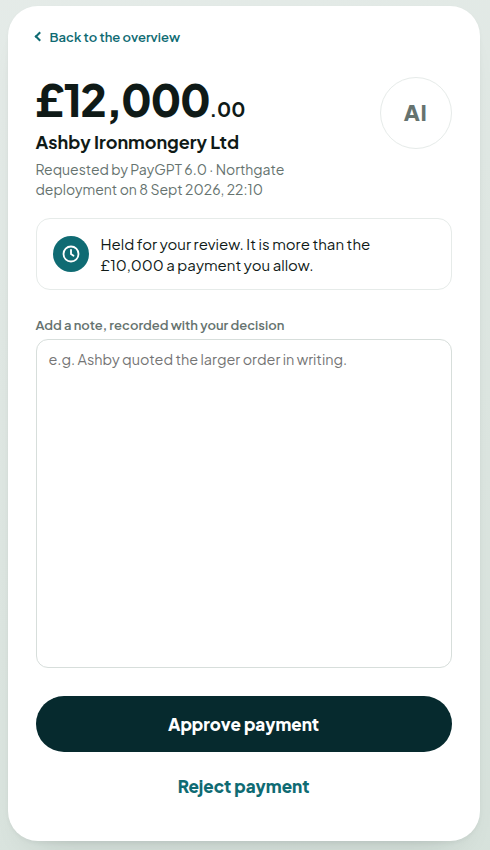
When the AI agent tries to pay the altered invoice, the bank holds it at the payee check for a person to review, and money never moves. What remains is a record the bank produced itself: who asked to pay whom, how much, which check stopped it and why, signed by the bank and chained to every earlier entry. The provider answers for its filing, the customer for its mandate, the bank for the check. A supervisor can read that record without operating any of it.
Powered by  vouch.finance
A passport is a promise. On vouch.finance the promise becomes money that can only be spent the way it was promised. When a customer signs its mandate, the bank mints an AI Voucher carrying the agent's limits, its payees and its passport. The bank runs the nine checks and the vouch policy engine authorises the settlement, so a refusal on one is a refusal on both. Suspend or revoke the passport and the voucher goes with it: the next instruction fails on every rail.